
Most crypto projects are a single business wearing a token. BlockDAG is designed differently, as a set of products that feed one another in a loop, and understanding that structure is the key to understanding its long-term case. One app is a business; several that reinforce each other form an economy.
This Spotlight walks through how BlockDAG‘s compounding loop is meant to work, from mining at one end to real-world spending at the other, and why a design like this can matter more than any single feature. The idea is straightforward: each product creates demand or activity that strengthens the next, so growth in one area lifts the others rather than staying isolated.
Whether the loop delivers depends on execution, but the design itself is what separates an ecosystem from a collection of unrelated apps, and it is worth examining on its own terms.
How the Loop Turns
Picture the cycle as a sequence that keeps returning to its start. More miners strengthen the network and distribute BDAG widely. A stronger, more active network attracts more developers, who build more applications. More applications bring more users, who generate more transactions. More transactions produce more revenue, which funds more product investment, which in turn supports more mining, and the loop begins again.

Each step feeds the next rather than standing alone. The design intent is that activity generated by any one product reinforces the underlying chain instead of operating as a separate business. That is the difference between a flywheel, where momentum compounds, and a set of disconnected services that each have to fight for growth on their own.
Concrete Links, Not Abstractions
The loop is easier to trust when made concrete. Take a single path: a person mines BDAG through the X1 app or a physical miner, then uses that BDAG inside the BlockDAG.com Casino, which has already taken $200 million in wagers. The revenue that casino activity generates can fund liquidity on the coming BlockDAG exchange. That exchange, in turn, gives every other product deeper markets and gives BDAG more trading utility, which draws more users back toward mining and the wider ecosystem.
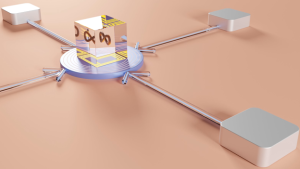
Another link: a developer building on BlockDAG reaches miners, wallet users, and casino players as a ready audience, and their app adds transactions that feed network revenue. These are specific handoffs, not slogans, and they show how one product’s output becomes another’s input.
Why a Revenue Loop Matters
The strategic payoff is independence from constant token sales. A project that relies on selling more tokens to fund itself faces perpetual sell pressure. A project with real revenue, from casino activity, exchange fees, payments, and developer services, can reinvest earnings into security, liquidity, and product quality, compounding over time.
That revenue connects to multiple demand sources for BDAG at once: network fees, holding through staking and tiers, trading through the exchange, consumer spending through the casino, application demand from developers, and payment demand through the Super App. When several independent demand streams feed one asset, the value case rests on structure rather than on a single product or a single announcement. That is the core of the compounding argument.
The Verdict
BlockDAG’s compounding loop is the strongest expression of its long-term thesis: no product stands alone, and each one is designed to strengthen the next. Miners distribute the asset, developers add demand, the casino and exchange generate revenue and liquidity, and the Super App keeps users inside the system. That structure earns a five-star editorial rating in this Spotlight for design coherence, with the standing caveat that a flywheel only compounds if each product executes, and the exchange and Super App have yet to launch.
Still, a revenue-generating economy that reinvests in itself is a fundamentally sturdier proposition than a single app selling tokens. The value case here is structural, and that is what makes it worth watching as the remaining pieces come online through 2026. Buyers can enter directly on the website at an entry rate of $0.000000017 alongside a $0.025 BuyBack price, with a buyback event scheduled for October 1. Alternatively, participants using Live Swap can secure tokens at a 22% discount below the current CoinMarketCap rate.

Presale: https://purchase.blockdag.network
Website: https://blockdag.network
Telegram: https://t.me/blockDAGnetworkOfficial
Discord: https://discord.gg/Q7BxghMVyu