

Inside Langston Wealth: An Australian Trader’s View of the Platform
I first looked at Langston Wealth expecting the usual trading-site experience: a long list of markets, a few charts and plenty of language about technology.
After spending some time moving through the website, the thing that stood out more was how much of the platform is built around the wider trading routine rather than simply placing an order.
That makes sense for Australian users. CFD’s Trading from Australia rarely means watching only the local market. What happens on Wall Street overnight can shape the next morning. Commodity prices matter. The Australian dollar matters. Asian markets are already moving while the local session is active, and Europe and the US take over later.
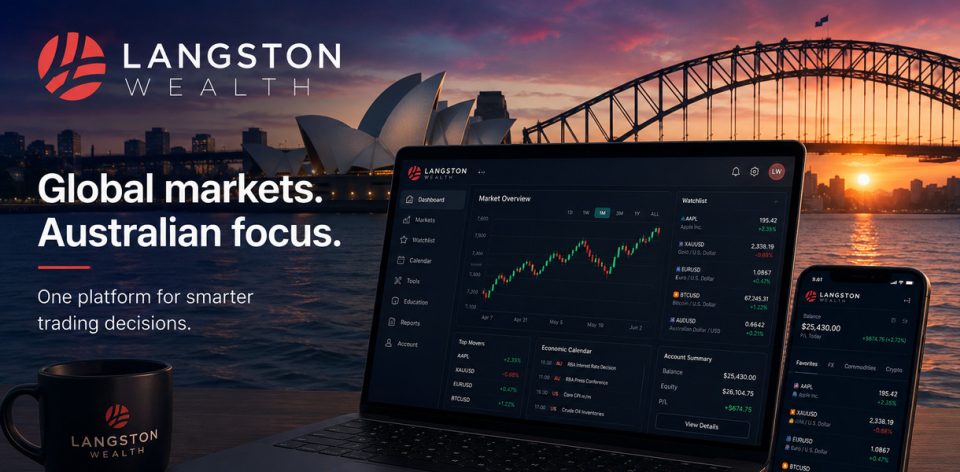
Langston Wealth seems designed with that wider day in mind. It combines international market access, account tools, mobile functionality, education and support in one environment rather than presenting each part as a separate product.
A Global Platform With an Australian Starting Point
Langston Wealth clearly speaks to Australian traders, but I would not describe it as an Australia-only platform.
The market offering is much broader than that. Users can follow global companies, currencies, indices, commodities, precious metals and digital assets from the same account.
What I like about that approach is that it reflects how markets actually work.
If I were following an Australian mining company, for example, I would probably also want to know what was happening with commodity prices and the Australian dollar. If I were watching a US technology stock, I might want to compare it with the wider index rather than looking at the company in isolation.
Having those markets relatively close together makes the research process feel less fragmented.
The platform does not remove the need to understand what you are trading, but it gives you a wider screen from which to look at it.
The Account Structure Is More Interesting Than I Expected
Langston Wealth uses five account levels: Core, Plus, Pro, Premium and VIP.
Core starts at $250, which makes it the obvious entry point. From there, the account levels increase quite sharply: Plus begins at $25,000, Pro at $50,000 and Premium at $100,000. VIP is handled through direct contact.
At first, those numbers make the structure look like a simple deposit ladder. Once I looked more closely, the differences are actually more about service.
Core gives users the essential platform tools and support. Plus adds a guided introduction, expanded tools and priority support. Pro introduces a dedicated account contact, weekly market briefings and a more personalized platform setup.
Premium moves further into the service side with a senior account contact, priority response and WhatsApp support. VIP is the most individual level, with one-to-one assistance and a tailored account configuration.
That distinction matters. A higher account level should offer more than another badge next to the account name, and Langston Wealth is clearly trying to differentiate the tiers through service and access as well as funding level.
The Data Tools Are Probably the Most Useful Part
One area I spent more time looking at was the market-data section.
Langston Wealth includes a Market Overview, Economic Calendar, Currency Cross Heatmap, Crypto Coins Heatmap and Trading Calculator.
None of those tools is revolutionary by itself, but together they make sense.
If I am looking at a currency pair and notice a sudden move, the economic calendar gives me somewhere obvious to check for a scheduled announcement. If several currencies are moving at once, the heatmap gives a faster visual read than opening each chart individually.
The same idea applies to crypto. Instead of staring at one coin and assuming the move is unique, the heatmap can help show whether activity is spreading across the wider digital market.
I also prefer having a calculator close to the trading environment. Position size, margin and other numbers are not the exciting part of trading, but they are often the part worth checking twice.
This is where I think Langston Wealth has a useful angle. It is not just giving traders more data. It is trying to keep the relevant data closer to the decision.
Trading From Australia Does Not End With the Local Session
Mobile access feels particularly relevant here.
An Australian trader can easily find themselves watching several different market sessions in one day. The ASX closes long before Wall Street does, and currency and digital markets continue beyond both.
Langston Wealth includes mobile trading as part of the wider account experience, allowing users to follow market activity and account information when they are away from a desktop.
I think the useful part of mobile trading is not being able to trade every second of the day. That can easily become a disadvantage.
The useful part is knowing that if something important happens, you can see your account, review an existing position or check what the market is doing without waiting until you get back to a computer.
That is a much more realistic way to think about “trading on the go.”
Support and Education Feel Like Part of the Product
Another thing I noticed is that Langston Wealth does not leave support and education completely outside the platform story.
Support is advertised 24/5, which makes more sense for a global-market platform than ordinary business-hour availability.
The amount of direct assistance also increases with the account level. Someone using Core gets the standard support structure, while higher tiers introduce dedicated contacts and more direct communication.
Education follows a similar approach.
The site includes beginner tutorials, market updates, risk-management material, a glossary, online-security guidance and getting-started information.
I would not treat any education centre as a shortcut to becoming a successful trader. What it can do is reduce the number of basic questions someone has to solve alone.
For a newer user, knowing where to find an explanation of a market term, an economic event or a platform feature makes the overall experience less intimidating.
Security Starts Before the First Trade
Langston Wealth also requires identity verification as part of account setup.
That means the security process begins before someone starts trading. Account ownership, personal information and payment details may need to be confirmed as part of KYC and funding procedures.
I actually think this part deserves more attention than most trading websites give it.
People tend to think of security as passwords and login screens. With a financial account, it also involves knowing who owns the account, where deposits are coming from and who is requesting a withdrawal.
Langston Wealth connects those processes through verification rather than treating them as completely separate events. The site also includes dedicated information around KYC and staying protected online.
For users, there is still a personal responsibility: keep login details private, use official communication channels and make sure account information remains current.
A Few Langston Wealth Facts Worth Remembering
There are a few numbers that make the platform easier to understand without reading every page:
- 5 account levels, from Core to VIP
- $250 Core starting level
- 24/5 client support
- Mobile trading available
- 5 integrated market tools
- Demo access available
Those facts tell the story of the platform better than a long list of marketing claims.
My Take on Langston Wealth in Australia
After going through the platform, I think Langston Wealth makes the most sense when viewed as an Australian starting point for a much wider trading day.
The local focus gives the platform some identity, but the experience itself is built around global markets, changing time zones and traders who may want more than one type of market in view.
The account structure gives users several levels of service. The market tools add useful context. Mobile access fits the reality of trading from Australia, and the education and support sections make the platform feel more complete than a simple order screen.
What I would not do is reduce Langston Wealth to one feature or one market.
The stronger proposition is the combination.
For Australian traders who want global access without turning their daily setup into a collection of disconnected tools and accounts, that is probably the most interesting part of Langston Wealth in 2026.