


The crypto vs stock market debate centers on comparing two distinct investment approaches: cryptocurrency trading involves digital assets with high volatility and 24/7 markets, while stock market investing focuses on company shares with established regulations and traditional trading hours.
Cryptocurrency markets now process over $50 billion in daily trading volume (CoinMarketCap, 2026), while global stock markets handle approximately $200 billion daily. This massive liquidity difference highlights just one of many factors new investors must consider when choosing their first investment platform.
Both markets offer unique opportunities for wealth building, but they operate under completely different rules. Stock markets provide ownership stakes in real companies with earnings reports and regulatory oversight. Cryptocurrency markets offer exposure to blockchain technology and decentralized finance, but with extreme price swings and limited regulatory protection.
The choice between crypto and stocks isn’t just about potential returns. It’s about matching your risk tolerance, time commitment, and financial goals with the right investment vehicle. Understanding these differences will help you make a more informed decision about where to start your investment journey.
Key Takeaways
- Stock markets offer more stability with average annual returns of 7-10%, while crypto can experience 50-90% price swings in weeks
- Cryptocurrency markets operate 24/7 globally, whereas stock exchanges have limited trading hours on weekdays only
- Stock investments provide regulatory protection through SEC oversight, while crypto regulations remain inconsistent across jurisdictions
- Entry barriers are lower for crypto with no minimum investment requirements, compared to stock brokers often requiring $500+ account minimums
- Diversification is easier in stock markets with thousands of companies across sectors, while crypto markets remain concentrated in fewer assets
- Learning curves differ significantly, with stock analysis focusing on company fundamentals versus crypto requiring technical and blockchain knowledge
- Tax implications vary, with stocks offering preferential long-term capital gains treatment that crypto investments also receive
- Risk management tools like stop losses and limit orders are more mature in traditional stock trading platforms
What’s New in 2026
The investment landscape has evolved significantly this year. Cryptocurrency ETFs now account for over $45 billion in assets under management, making crypto exposure available through traditional brokerage accounts. This development bridges the gap between crypto and stock investing for beginners.
Regulatory clarity has improved with the SEC establishing clearer guidelines for digital assets. Major brokerages now offer both stock and crypto trading on unified platforms, reducing the complexity of managing multiple accounts.
Artificial intelligence tools have become standard features on most trading platforms, providing automated portfolio rebalancing and risk assessment for both asset classes. These tools help beginners make more informed decisions without extensive market knowledge.
Understanding Risk Profiles and Return Expectations
Risk tolerance forms the foundation of any investment decision. Both markets carry risks, but the nature and magnitude differ dramatically.
1. Volatility Comparison
Stock market volatility typically ranges from 15-25% annually for broad market indices. Individual stocks can experience higher volatility, but blue-chip companies generally provide steadier price movements. During market corrections, stocks might decline 20-30% before recovering.
Cryptocurrency volatility often exceeds 80% annually for major coins like Bitcoin and Ethereum. Smaller altcoins can experience 200-500% price swings within months. This extreme volatility creates opportunities for significant gains but also substantial losses.
2. Historical Performance Analysis
Stock markets have delivered consistent long-term returns over decades. The S&P 500 has averaged approximately 10% annual returns since 1957, despite periodic bear markets and recessions.
Cryptocurrency performance shows explosive growth periods followed by severe corrections. Bitcoin has achieved over 100% annual returns in some years but also declined by 80% or more during bear cycles.
3. Risk Management Tools Available
Stock markets offer mature risk management through diversified index funds, dividend-paying stocks, and established options markets. Investors can hedge positions and generate income through covered calls or protective puts.
Crypto markets provide fewer sophisticated risk management options. While futures and options exist for major cryptocurrencies, the tools remain less developed than traditional finance offerings.
Getting Started: Practical Steps for Each Market
Your first steps depend on which market aligns with your goals and risk tolerance.
Step 1: Assess Your Financial Situation
Determine how much you can afford to invest without affecting essential expenses. Financial advisors typically recommend investing only money you won’t need for at least five years. For crypto, many experts suggest limiting exposure to 5-10% of your total investment portfolio.
Step 2: Choose Your Platform
For stocks, consider established brokerages like Fidelity, Schwab, or Vanguard that offer commission-free trading and extensive research tools. For crypto, platforms like Coinbase, Kraken, or Gemini provide user-friendly interfaces with educational resources.
Step 3: Start with Broad Exposure
Stock beginners should consider low-cost index funds that track the S&P 500 or total stock market. These provide instant diversification across hundreds of companies. Crypto beginners might start with Bitcoin and Ethereum before exploring smaller altcoins.
Step 4: Develop a Learning Plan
Stock investing requires understanding financial statements, price-to-earnings ratios, and market cycles. Crypto investing demands knowledge of blockchain technology, tokenomics, and decentralized finance concepts. Allocate time weekly to expand your knowledge in your chosen area.
Step 5: Implement Dollar-Cost Averaging
Invest fixed amounts regularly regardless of market prices. This strategy reduces the impact of volatility and removes emotion from investment timing decisions. Set up automatic investments monthly or bi-weekly.
Market Structure and Accessibility Comparison
Understanding how each market operates helps you choose the environment that suits your preferences and schedule.
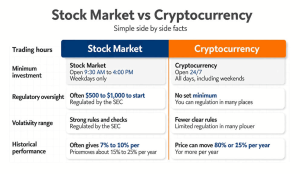
| Feature | Stock Market | Cryptocurrency |
|---|---|---|
| Trading Hours | 9:30 AM – 4:00 PM ET, weekdays only | 24/7, including weekends |
| Minimum Investment | Often $500-1000 broker minimums | No minimum, can buy fractional coins |
| Regulatory Oversight | SEC regulated, investor protections | Limited regulation, buyer beware |
| Settlement Time | T+2 (two business days) | Minutes to hours depending on blockchain |
| Market Maturity | Over 100 years of established trading | 15 years old, still developing |
| Available Assets | 4000+ individual stocks, thousands of funds | 10,000+ cryptocurrencies, varying quality |
| Research Tools | Extensive fundamental analysis available | Limited fundamental analysis, mostly technical |
| Insurance Protection | FDIC insurance on cash, SIPC on securities | No government insurance protection |
| Transaction Costs | Often commission-free for stocks | Network fees plus exchange fees |
| Tax Reporting | Standardized 1099 forms provided | Manual tracking often required |
Use Cases
Different investment goals align better with each market’s characteristics.
1. Retirement Planning
Stock markets excel for retirement planning through tax-advantaged accounts like 401(k)s and IRAs. The predictable long-term growth and dividend income make stocks suitable for building retirement wealth over 20-40 year periods.
Cryptocurrency can supplement retirement planning but shouldn’t form the foundation. The volatility makes it unsuitable as a primary retirement vehicle, though small allocations might boost long-term returns.
2. Emergency Wealth Building
Crypto markets attract investors seeking rapid wealth accumulation. The potential for 10x or 100x returns appeals to those willing to accept extreme risk. However, the probability of losing 50-90% of investment is equally high.
Stock markets offer more reliable wealth building through compound growth. While returns develop slowly, the consistency makes stocks better for systematic wealth accumulation over time.
3. Portfolio Diversification
Bitcoin vs the Ethereum debate illustrates how crypto can diversify investment portfolios. Cryptocurrency correlations with stocks have decreased, providing some hedging benefits during certain market conditions.
Stock diversification works through sector allocation, geographic exposure, and market capitalization differences. Real estate investment trusts, international funds, and growth versus value stocks create comprehensive diversification.
4. Active Trading Opportunities
Cryptocurrency markets reward active traders with 24/7 opportunities and frequent price movements. Day trading crypto can generate profits from volatility, though it requires significant time commitment and risk tolerance.
Stock markets support various trading strategies from swing trading to momentum investing. The mature options markets enable income generation through covered calls and cash-secured puts.
5. Passive Investment Approaches
Stock index investing provides the ultimate passive strategy. Set up automatic investments in low-cost funds and ignore daily market fluctuations. This approach has created wealth for millions of investors over decades.
Crypto passive investing works through dollar-cost averaging into major cryptocurrencies. While more volatile than stock investing, the strategy removes timing decisions and emotional trading mistakes.
Pros and Cons
Each market presents distinct advantages and disadvantages for beginning investors.
Stock Market Pros:
- Regulatory protection and established investor rights
- Extensive research and analysis tools available
- Professional management options through mutual funds
- Dividend income provides cash flow during retirement
- Tax-advantaged retirement account compatibility
- Mature risk management and hedging strategies
- Transparent company financial reporting requirements
Stock Market Cons:
- Limited trading hours restrict flexibility
- Slower wealth accumulation potential
- Complex financial statement analysis required
- Market manipulation by institutional investors
- Economic recession vulnerability
- Inflation can erode purchasing power over time
- Higher account minimums at some brokerages
Cryptocurrency Pros:
- 24/7 trading allows flexible scheduling
- Potential for explosive returns and wealth building
- Low barriers to entry with fractional ownership
- Exposure to cutting-edge blockchain technology
- Decentralized finance opportunities
- Global accessibility without geographic restrictions
- IPO Genie vs Launchpads shows innovation in investment access
Cryptocurrency Cons:
- Extreme volatility can cause severe losses
- Limited regulatory protection for investors
- Complex technical knowledge requirements
- Security risks including exchange hacks
- Tax reporting complexity and confusion
- Market manipulation by large holders
- Environmental concerns with energy consumption
Making Your Decision: A Framework for Beginners
Choose your investment approach based on your specific situation and goals.
1. Risk Assessment
If you lose sleep over 10% portfolio declines, stick to stock index funds and established companies. Your emotional well-being matters more than potential returns. If you can handle 50% drops without panic selling, cryptocurrency exposure might suit your temperament.
2. Time Horizon Evaluation
Investments needed within five years belong in conservative options like CDs or money market funds. Medium-term goals (5-15 years) work well with diversified stock portfolios. Long-term wealth building (15+ years) can incorporate higher-risk investments including cryptocurrency.
3. Knowledge and Interest Level
Stock investing requires understanding business fundamentals, financial ratios, and economic indicators. If you enjoy researching companies and analyzing earnings reports, stocks provide intellectual engagement.
Crypto investing demands technical knowledge about blockchain technology, smart contracts, and decentralized applications. If technology trends fascinate you and you enjoy learning about digital innovations, cryptocurrency might align with your interests.
4. Available Time Commitment
Passive stock investing through index funds requires minimal ongoing attention. Review your portfolio quarterly and rebalance annually. This approach suits busy professionals and those preferring hands-off investing.
Active crypto investing demands daily market monitoring and constant learning about new projects and technologies. Price movements happen around the clock, requiring more attention than traditional investing.
Conclusion
The crypto vs stock market decision ultimately depends on your personal financial situation, risk tolerance, and investment objectives. Neither choice is inherently superior; they serve different purposes in a complete financial strategy.
Stock markets provide the foundation for most successful long-term investment plans. The stability, regulatory protection, and historical performance make stocks essential for retirement planning and steady wealth building. Beginning investors should understand stock market basics regardless of their crypto interest.
Cryptocurrency can enhance portfolio returns and provide exposure to technological innovation. However, it works best as a supplement to traditional investments rather than a replacement. The volatility and regulatory uncertainty make crypto unsuitable as your primary investment vehicle.
Consider starting with stock index funds to build your investment foundation, then gradually adding cryptocurrency exposure as you gain experience and knowledge. This balanced approach captures the benefits of both markets while managing overall portfolio risk. Your future financial success depends more on consistent investing habits than perfect market timing or asset selection.
FAQ
1. Which is safer for beginners, crypto or stocks?
Stocks are generally safer for beginners due to regulatory protection, lower volatility, and established track records. The SEC provides investor protections and requires transparent financial reporting from public companies. Cryptocurrency markets lack these safeguards and experience much higher volatility that can result in significant losses for inexperienced investors.
2. How much money do I need to start investing in each market?
Stock investing often requires $500-1000 minimum account balances at traditional brokerages, though some platforms allow smaller amounts. Many brokers now offer fractional share purchases starting at $1. Cryptocurrency has no minimum investment requirements and you can purchase fractional coins for any dollar amount, making it more accessible for small investors.
3. Can I invest in both crypto and stocks simultaneously?
Yes, many investors diversify across both markets to balance risk and return potential. A common approach allocates 80-90% to stocks and 10-20% to cryptocurrency. Several modern brokerage platforms now offer both asset classes on unified accounts, simplifying management and tax reporting.
4. Which market offers better long-term returns?
Stock markets have delivered consistent 7-10% annual returns over decades with lower volatility. Cryptocurrency has achieved higher returns during bull markets but also experiences severe bear markets with 80%+ declines. The limited historical data makes long-term crypto performance projections unreliable compared to stocks’ century-long track record.
5. How do taxes differ between crypto and stock investments?
Both crypto and stocks receive similar tax treatment as capital assets. Long-term holdings (over one year) qualify for preferential capital gains rates of 0%, 15%, or 20% depending on income. However, crypto tax reporting is more complex as you must track every transaction, including crypto-to-crypto trades, while stock transactions are automatically reported on 1099 forms.