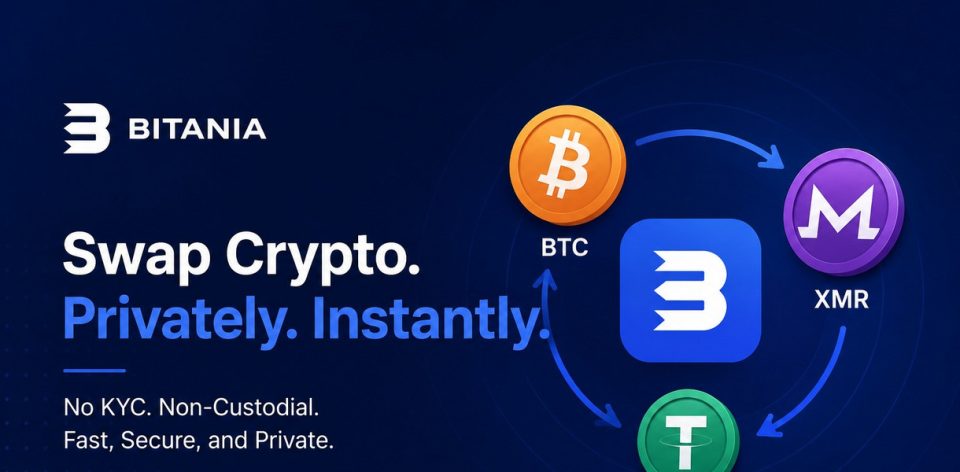

A cryptocurrency portfolio doesn’t necessarily need too many tokens. For a lot of users, three tokens are enough for various needs: Bitcoin, Monero, and USDT.
Bitcoin provides users with exposure to the largest decentralized monetary network in the crypto ecosystem. Monero makes transaction privacy the priority of its design. USDT, on the other hand, allows users to access dollar-pegged liquidity within the crypto sphere.
However, the most important part isn't only holding these assets. The real headache often comes from moving between one asset and another.
That makes crypto swaps increasingly useful, particularly for users who want to move from BTC to XMR, USDT to XMR, or XMR to USDT without opening another KYC-heavy exchange account.
Bitania's swap service aims to connect those different use cases through a no-KYC conversion experience.
Bitcoin: The Core Crypto Asset
Bitcoin remains the reference point for the wider cryptocurrency market.
While many investors prefer to hold BTC as their principal cryptocurrency investment in the long run, there are also traders using it as a means of entering into different types of cryptocurrencies.
However, the Bitcoin blockchain is transparent. All transactions are visible to the public, plus with the help of advanced blockchain analytics, investigators can study and trace bitcoin activity. That’s why users who want to keep their transactions private prefer to swap BTC to XMR.
Both assets don’t replace each other’s role in any way. A user can value Bitcoin’s network while still adopting Monero when they want to protect their financial privacy. A direct Bitcoin to Monero swap creates the bridge.
Monero: When Privacy Takes Priority
Monero’s approach to crypto is quite different. Privacy isn't optional here. Instead, it forms a central part of how the Monero network handles transactions.
That has made Monero a go-to privacy coin for users who disagree with the idea that financial transactions should exist as an easily readable public record.
Yet acquiring XMR can create a privacy paradox.
If someone has to connect a passport, selfie, residential address, phone number, and exchange account to their purchase, they have already created a significant identity record around the transaction.
This is why no KYC Monero exchange and swap services attract privacy-focused users.
Bitania takes that approach by stating that identity verification isn't required for its swapping and trading services.
USDT: Crypto's Liquid Waiting Room
Then there is USDT (Tether). USDT doesn't offer Bitcoin's monetary proposition or Monero's privacy model. What it offers is price stability and liquidity, which comes from its dollar peg.
A trader may choose to switch to USDT after selling another coin, like Monero. They can keep that value within crypto until they decide what to do next.
That creates two useful Monero routes:
- A trader holding stablecoin liquidity can make a USDT to XMR swap when they want Monero.
- An XMR holder can swap Monero to USDT when they want a dollar-linked value.
Neither move necessarily represents a permanent portfolio decision. Crypto users constantly reposition assets depending on what they need at a particular moment.
Three Assets, Multiple Routes
This is where a swap platform becomes more interesting than a single trading pair.
Consider several possible movements.
A BTC holder wants more privacy and swaps Bitcoin for Monero.
An XMR holder wants stablecoin liquidity and completes an XMR to USDT swap.
A USDT holder decides to acquire privacy-focused crypto and chooses a Tether to Monero swap.
The assets stay the same, but each transaction solves a different problem.
A swap service connects them without requiring users to navigate an entire exchange ecosystem every time their needs change.
Why No-KYC Matters in This Model
The ability to move between assets matters, but so does the amount of information users surrender along the way.
Many crypto users use more than one wallet, exchanges, payment providers, and apps. So, creating a verified account with every service expands their digital footprint.
A no-KYC crypto swap offers a more data-minimal alternative for straightforward conversions.
Bitania explicitly extends its no-KYC approach to swapping, giving privacy-conscious users a route between supported cryptocurrencies without mandatory identity verification.
That fits especially naturally with XMR.
When the person opts for Monero to protect their privacy, they should also put the platform they use to either acquire or exchange the crypto into consideration. Using the wrong platform can put that privacy at risk, defeating the entire purpose of using Monero in the first place.
Bitania Connects the Pieces
BTC, XMR, and USDT provide great examples of how various cryptocurrencies can complement each other.
For instance, Bitcoin introduces people to the biggest cryptocurrency network in the world. Monero emphasizes private digital transactions. USDT provides stablecoin liquidity.
Users don't necessarily need to choose one and abandon the others. They need infrastructure that lets them move between them. That's the role Bitania's swap service is trying to fill.
Whether someone wants a BTC to XMR swap, needs to swap USDT to XMR, or wants to move XMR to USDT, Bitania provides a common route built around straightforward crypto conversion and a no-KYC philosophy.
In a market obsessed with adding more tokens and more features, connecting the assets people already use may prove just as valuable.