
Every few years, the crypto market goes through a filter. Crypto Projects appear in waves, but only a handful remain once the excitement fades. The pattern is familiar: bold promises in the beginning, growth during a market cycle, and then silence if the foundations aren’t solid. What’s left standing are the systems that prove they can carry activity, attract builders, and adapt when conditions change.
It helps to compare this to everyday tools. Think of the apps on your phone. Many get downloaded, tested for a few days, and then deleted. But there are a few maps, messaging, payments that stay because they serve a function you return to again and again. Cryptocurrencies are no different. The ones with endurance are those that keep solving a problem people actually face.
In 2025, the crypto market will be more layered than before. Some platforms focus on raw speed, giving blockchains the ability to handle thousands of actions without slowing down. Others prioritize data integrity, ensuring that information flows in and out of networks without being distorted. A growing group targets advanced use cases such as artificial intelligence or immersive digital environments, where demand for decentralized systems is expanding rapidly.
The central question is not about which crypto project has the loudest community or the sharpest short-term rise. It is about which networks form the backbone of something larger. Which ones become part of the digital infrastructure people lean on without even thinking about it? Those are the tokens with the most room to grow, because they are tied to systems that do not disappear once the market cools.
| Category | What It Means in Practice |
| Infrastructure | The rails: speed, security, and reliability |
| Data & Connectivity | Bridges that move trusted information between chains |
| Specialized Systems | Platforms for AI, graphics, or immersive spaces |
| Governance & Control | Ways communities and participants steer development |
When you view the space through this lens, the noise starts to fade. What remains is a smaller group of projects building in directions that match the broader evolution of technology. They are not simply riding the market; they are weaving themselves into how digital systems will work in the coming years.
What Defines Real Potential in Crypto
When discussing digital assets, it’s easy to mistake short-term activity for long-term significance. Real potential is not measured by temporary excitement but by whether a project becomes part of the systems people continue to use.
Several elements define this:
- Purpose that is clear: a token must connect to something practical, not just exist for speculation.
- Capacity to scale: as more people use it, the network should remain stable and efficient.
- Structures of governance: projects that allow participation in decision-making tend to last longer than those led by a closed team.
- Flexibility to evolve: technology, regulation, and demand change; networks that adapt survive those shifts.
| Defining Element | Impact on Longevity |
| Clear Purpose | Keeps demand tied to actual use cases |
| Scalability | Prevents breakdowns as adoption grows |
| Governance | Enables resilience through community involvement |
| Flexibility | Ensures relevance as conditions and tech transform |
Viewed through this lens, the difference between noise and substance becomes obvious. The projects that demonstrate these traits steadily move into positions of influence, while others fade as quickly as they appeared. Potential, then, is not about speculation it is about becoming infrastructure that others rely on.
The Eight Crypto in our List
Before diving deeper, here’s a quick look at the eight cryptocurrencies explored in this article:
- EarthMeta (EMT): digital twin of Earth
- Chainlink (LINK): decentralized data bridge
- The Graph (GRT): blockchain data indexing
- Hedera (HBAR): hashgraph-powered transactions
- Render (RNDR): decentralized GPU network
- Bittensor (TAO): AI knowledge marketplace
- Aptos (APT): scalable Layer-1 blockchain
- Solana (SOL): high-speed blockchain platform
Best Crypto with High Potential: Our Top 8 Coins for 2026-2027
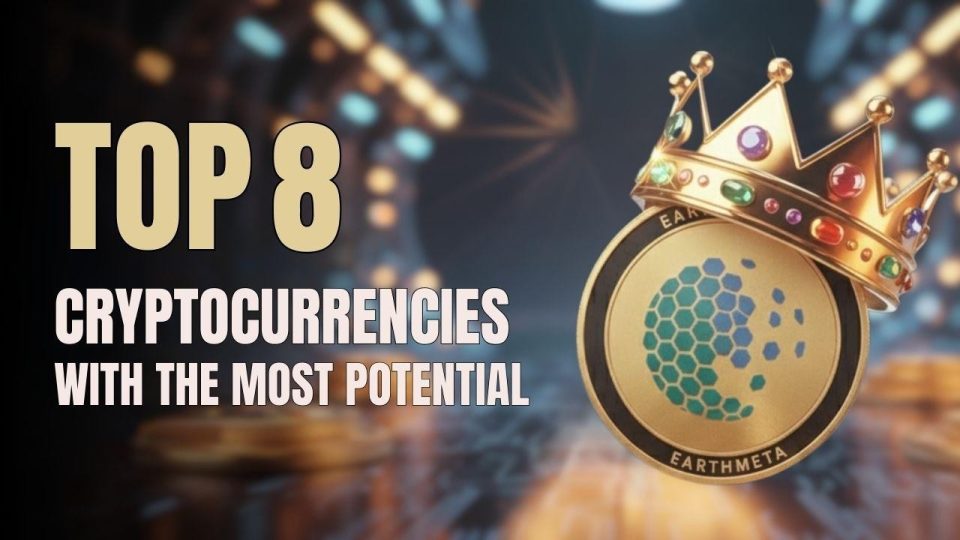
1. EarthMeta (EMT)
Imagine walking through a city that looks and feels real, yet exists entirely in the digital world. Streets, monuments, landmarks all there, waiting for someone to own, shape, and build upon. This is the vision of EarthMeta: a perfect digital twin of our planet, where every city becomes an opportunity and every landmark tells a story.

In EarthMeta, you don’t just hold a token, you hold a place. Buying a city makes you its Governor, with the power to divide it into assets such as monuments, buildings, or districts. Every time these assets are traded, you collect a share. Build wisely, and your influence grows. Rise high enough, and you can become President of an entire country, shaping its identity and earning even more recognition.
But ownership is only the beginning of the dream. EarthMeta integrates augmented and virtual reality, so your digital assets aren’t just numbers on a blockchain they can be explored, walked through, and experienced. Picture standing in front of a digital Eiffel Tower that you own, or hosting events inside a virtual Times Square.
Behind this immersive vision is AI-powered intelligence, helping Governors evaluate assets, design economies, and manage their territories fairly. And thanks to its foundation on Polygon, EarthMeta ensures fast, transparent, and low-cost transactions, with a marketplace that is truly decentralized where value flows directly to the community.
What makes this project unique is its scarcity and authenticity. Unlike others that divide the world into endless squares, EarthMeta mirrors real geography with a limited number of cities. Every city is unique, every asset carries weight, and ownership feels real.
Some highlights of EarthMeta’s dream-driven design include:
- A true digital Earth where every city matters.
- Governors and Presidents, turning ownership into leadership.
- Immersive AR/VR experiences, bringing digital spaces to life.
- AI-driven tools for smarter and fairer decision-making.
- A decentralized marketplace that keeps control in your hands.
EarthMeta is more than just another crypto project; it’s an invitation to step into a living, breathing digital Earth. For those who dream bigger, EMT offers the chance to own a piece of the future today.
2. Chainlink (LINK)
Blockchains are powerful, but they can’t see the outside world on their own. They need accurate data prices, weather, shipping details, even random numbers to make smart contracts actually work. This is where Chainlink changes the game.

By acting as a secure bridge between blockchains and real-world information, Chainlink ensures that digital agreements can run with trusted data. Today, it supports major DeFi protocols, NFT projects, gaming platforms, and even partnerships with companies like AccuWeather and FedEx.
Why does this make LINK one of the top cryptos with potential? Because as crypto expands, every application needs reliable data. From lending platforms to insurance contracts, if the information is wrong, the system breaks. Chainlink’s oracles solve that problem, and its cross-chain protocol (CCIP) now allows communication between different blockchains as well.
In short, LINK is the backbone of trust in crypto. As the ecosystem grows, its role only becomes more essential, securing its place as one of the most important tokens in 2025.
3. The Graph (GRT)
Every decentralized app needs data. Whether it’s tracking trades on Uniswap, ownership of NFTs, or balances in lending pools, that information must be organized and accessible. The Graph makes this possible.

Instead of forcing developers to search entire blockchains for data, a slow and heavy process The Graph provides subgraphs, open APIs that deliver structured blockchain data instantly. This is why so many Web3 projects, from DeFi platforms to NFT marketplaces, rely on it every day.
Its network is powered by Indexers, Curators, and Delegators, who keep the data accurate, available, and easy to query. In return, they use and earn GRT, the token that drives the ecosystem.
Why is GRT one of the top cryptocurrencies with potential? Because every blockchain project needs fast, reliable access to data. As crypto scales across industries, The Graph functions as the “Google of blockchains,” ensuring apps can actually work for millions of users.
In short, GRT is not optional infrastructure, it’s essential.
4. Hedera (HBAR)
Most blockchains struggle with the same issues: slow speeds, high costs, and energy use. Hedera takes a different path. Instead of a traditional chain of blocks, it uses hashgraph technology, a unique system where transactions spread quickly across the network through a “gossip-about-gossip” method. This makes it fast, secure, and efficient, capable of handling thousands of transactions per second at a fraction of the cost.

Hedera also stands out for its governing council, made up of global companies and institutions across multiple industries. This structure gives the network stability, credibility, and direction, something rare in the crypto world.
The native token, HBAR, powers the ecosystem by paying for transactions, securing the network through staking, and fueling decentralized applications. With services for token creation, consensus, smart contracts, and file storage, developers have the tools to build powerful real-world solutions.
Why does HBAR have strong potential? Because as crypto adoption grows, speed, low costs, and reliability are no longer optional and Hedera is already delivering them.
5. Render (RNDR)
Behind every movie scene, 3D model, or AI image is one key ingredient: massive GPU power. Traditionally, this kind of computing is expensive and controlled by centralized providers. Render changes that by creating a decentralized network where anyone with spare GPU capacity can share it, and creators can tap into it when they need scale.

This model unlocks resources for artists, developers, and studios working on everything from film-quality effects to generative AI projects. At the same time, node operators earn rewards for providing their unused hardware power. It’s a system where creativity meets efficiency.
By 2025, the demand for GPU computing has exploded, driven by AI, gaming, and immersive experiences. Render stands out because it’s not just a crypto token, it’s the backbone of a working network that delivers speed, scalability, and cost-effectiveness.
Why does RNDR have strong potential? Because every digital economy needs graphics and compute power and Render offers it in a way that’s open, global, and sustainable.
6. Bittensor (TAO)
Artificial intelligence is shaping nearly every industry, but access to it is often controlled by a few large companies. Bittensor changes this by creating a decentralized network where AI models are trained, shared, and rewarded openly.

On Bittensor, developers and contributors collaborate to grow a collective pool of intelligence. Each contribution is measured by its informational value; the more useful the model or data, the greater the reward in TAO, the network’s native token. This turns AI into a true marketplace, where value flows directly to those who create and improve it.
Because it’s decentralized, no single company can dominate the system. Anyone can contribute computing power, models, or data, and anyone can access the shared intelligence that emerges from the network.
Why is TAO one of the top cryptos with potential? Because demand for AI skyrockets, Bittensor provides a way to democratize innovation making advanced intelligence accessible, open, and incentivized on a global scale.
7. Aptos (APT)
Most blockchains slow down when activity rises. Aptos approaches this problem differently. Instead of processing transactions one after another, it runs them in parallel, allowing the network to handle massive traffic without losing speed. Tests have shown it can reach well over 100,000 transactions per second, placing it among the fastest blockchains in existence.

Another key difference is the use of Move, a programming language first created during Meta’s Diem project. Move is designed for safety and flexibility, giving developers the tools to build applications that are both secure and upgradeable. This makes Aptos attractive for consumer apps, gaming, and large-scale platforms that need reliability.
The APT token fuels this ecosystem paying for transactions, securing the network through staking, and enabling governance.
Why does APT have strong potential? Because as web3 pushes into mainstream use, speed, security, and scalability are no longer optional. Aptos was built from the ground up with these in mind, making it one of the top blockchains to watch in 2025.
8. Solana (SOL)
In the world of crypto, speed and cost matter. Solana sets itself apart by processing thousands of transactions per second while keeping fees extremely low. This makes it one of the fastest and most efficient blockchains available today.

At the heart of Solana is its hybrid consensus model, combining Proof-of-History (PoH) with Proof-of-Stake (PoS). This design timestamps and validates transactions quickly, avoiding bottlenecks that slow down other networks. The result is a platform that supports DeFi, NFTs, gaming, and Web3 applications at internet-scale speed.
The SOL token fuels this ecosystem securing the network, paying for transactions, and powering decentralized applications.
Why does SOL have strong potential? Because developers, creators, and users need a blockchain that feels smooth and reliable. As crypto adoption grows, fast settlement and low fees are non-negotiable, and Solana delivers both. Despite challenges, it continues to be one of the most active and innovative ecosystems, making it a leading candidate for long-term relevance in 2025.
Our Take on the Future of High-Potential Cryptos
When we look at the projects shaping 2025, one theme becomes clear: potential is less about short-term activity and more about long-term resilience. The examples highlighted EarthMeta, Chainlink, The Graph, Hedera, Render, Bittensor, Aptos, and Solana all show how endurance is built on clear function, adaptability, and integration into larger systems.
These are not tokens surviving on noise; they are systems becoming part of the digital foundation itself. Our take is simple: the future belongs to projects that can evolve, remain useful, and continue to connect technology with people’s needs long after the market cycle shifts.
Which Crypto Has the Most Potential?
There is no single “winner,” but EarthMeta stands out as one of the projects with the strongest case. By creating a digital twin of Earth where cities and landmarks can be owned and managed, it bridges virtual and real-world logic. Features like AI integration, staking pools, and decentralized governance give it layers of adaptability. While many projects compete on speed or data, EarthMeta competes on experience offering something tangible and recognizable that users can build on.
Where Can I Find the Best Crypto Coins?
The best crypto projects are usually found where technology, governance, and clear function meet. They are not hidden; they’re being built openly, with transparent roadmaps and active communities. EarthMeta, for example, publishes its roadmap and whitepaper, outlining phases from AR apps to staking pools and cross-chain compatibility. Exploring such documents, following communities, and tracking developer activity is the best way to spot which tokens have room to grow.