

On March 12, Outset Media Index (or OMI) launched as a media benchmarking platform for advertisers, PR and communications teams, publishers and analysts who regularly need to review media outlets before placing campaigns, building media partnerships or shaping visibility strategies.
That overview typically requires looking at a few key things at once – how much traffic a publication attracts, how visible it is in search, where its readers come from and how people engage with its stories.
OMI gathers 37 metrics related to traffic, SEO and AI visibility, reader engagement and editorial workflows into one place so outlets can be analyzed through one dataset.
The question of media performance has become more pressing as publishers search for sustainable digital business models. Many outlets are experimenting with memberships or reader-supported initiatives as audiences spread across multiple platforms.
Yet, convincing readers to pay remains difficult. A Reuters Institute study of the Italian media market found that only 9% of respondents currently pay for digital news, which shows how challenging subscription-based strategies can be.
In an environment like this, understanding which publications actually attract and retain audiences becomes increasingly important for both media brands and the teams that work with them, and that’s exactly what OMI does.
More than 340 publications are currently tracked in the index, including crypto-focused outlets as well as finance, technology and general news sites that frequently report on cryptocurrency and blockchain matters.
Reading the Signals Behind Media Performance with OMI
In the platform interface, outlets appear within a ranking table where each row represents a publication and the columns display the indicators attached to it. Users can sort the list according to different metrics or narrow it down using filters such as primary audience region, media type, traffic levels, engagement indicators or domain authority.
The table can also be customized so that only selected indicators appear in the view, allowing analysts to focus on the signals most relevant to a particular campaign or research task.
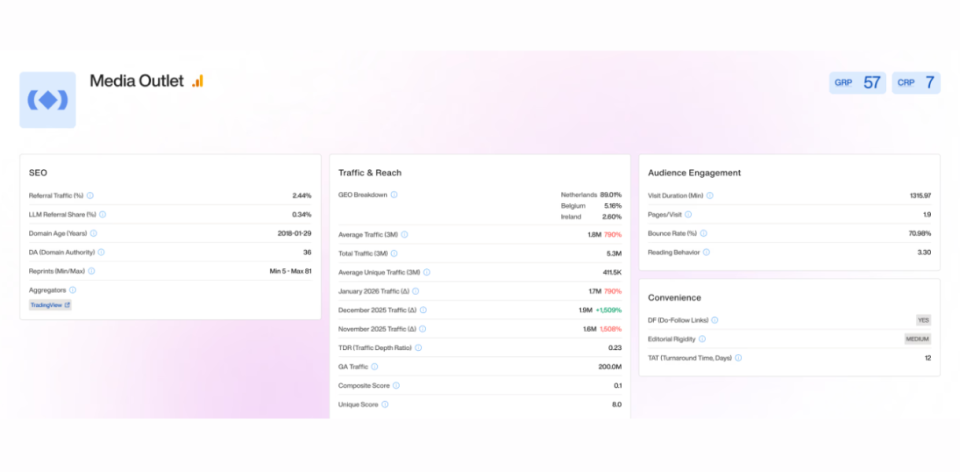
From there, users can move beyond the aggregated view and examine individual publications in more detail. Each outlet within OMI opens into a dedicated profile that expands on the signals attached to it. These profiles bring together metrics such as audience geography, visitor behavior, domain history, referral patterns and other operational data points that help contextualize how a publication performs within the broader media landscape.
Image source: omindex.io
By presenting this information alongside the wider dataset, the index allows analysts to move from a high-level overview of the market to a closer examination of how a specific outlet attracts and retains its readers.
Within those profiles, the indicators themselves become the main analytical layer. Some of them will be familiar to anyone who works with media data, such as traffic estimates, search visibility, audience geography or engagement metrics that reflect how long visitors stay on a site and whether they continue browsing beyond a single article.
Alongside these widely used signals, OMI also introduces several proprietary indicators developed from years of practical media work. Composite Score tracks whether an outlet’s audience is expanding, shrinking or remaining stable over time, while Reading Behavior combines engagement metrics to give a reliable look at how deeply readers interact with published content once they arrive. Another parameter, Reprints, reflects how coverage expands beyond the outlet where it first appeared, and highlights publishers whose articles frequently show up on aggregators or secondary platforms.
While many parameters can be examined individually, OMI also combines them into two summary scoring frameworks for quick comparison. The General Rating reflects overall outlet performance within the index, while the Convenience Rating focuses on operational signals that influence how easily teams can collaborate with a publication.
The dataset also undergoes a normalization process. This step adjusts raw values so unusually large figures do not distort comparisons between outlets. By standardizing the inputs in this way, the system helps ensure that the indicators reflect relative performance rather than scale differences between publications.
The analytical work behind OMI also supports Outset Data Pulse, which takes the trends shown in the index and analyzes the changes across regions that these numbers reveal.
Speaking of regions, the Reuters Institute study on Italy mentioned earlier also points to another change in how audiences reach news. While the report focuses on the Italian media market, many of the patterns it describes echo changes visible across other regions as well, where readers increasingly encounter stories through search engines, social platforms and aggregators rather than visiting publisher homepages directly.
As more and more ways to reach news appear, competition for audience attention intensifies and identifying the outlets that truly retain readers becomes more difficult. In the years ahead, more tools like Outset Media Index may start appearing as the industry looks for better ways to make sense of all this.