

General Guidelines
- The articles should adapt to the content published by the website on which the article will be posted. Check 3 to 5 articles on the website (preferably in the section in which the article will be posted) to see more or less their style including:
- Length mimics the length of the rest of the articles on the publisher’s website. Check 3 to 5 articles in the section in which our article will go to determine the average length (if their content is very short – less than 500 words – then stick to a minimum length of 500 words). This will be provided in the brief. Please try to stick to this within around 10% above or below the min/max provided.
-
- Links: we should mimic the use of links the website normally uses, both external and internal.
- If the website doesn’t seem to use external links please include at least 2 more links on top of ours.
-
- Don’t link to competitors or to articles with a link to any other companies or competitors
- When internal linking, do not link to search results. Articles are always better.
- Headers: use them when the website uses them. If the website normally writes one block type of content, please follow that style.
- Conclusions/summary: only add them if the website does normally end their articles with a conclusion section.
- Again, this will usually be indicated in the brief.
- It’s recommended for the article to include journalistic research and authoritative facts.
- Best to include facts using phrases such as ¨ as mentioned…¨ ¨as reported by…¨ ¨a spokesperson…¨
- ALWAYS open the target URL* before writing the article to get a clear idea of what the client wants to link to and what text to add around the anchor*.
- When possible, it’s good to quote or refer to a part of the content from the URL. This makes the link placement more relevant.
-
- Topics:
- Think of the audience. If it’s a sports site we don’t need to explain what the Premier League is for instance or if it’s a finance or crypto article for a crypto-related site we don’t need to explain what cryptocurrency is either.
- Topics:
- The topic should fit both the domain and the target URL.
-
-
- Although it is always more relevant to talk about gambling, we can vary the topics as long as they allow a natural placement of our link.
- Here are some examples of topics and how to connect them to our target.
- IMPORTANT: Please avoid talking about family or kids-related topics (anything about minors), any sort of addiction, promising big wins/how you can make money from gambling. If you are unsure, please ask Emily or Christine for clarification.
- If you are writing an article for a casino URL, please do not choose a sports topic (unless it is a sports-based website that only publishes sports artices, then we can do something like gambling/casino sponsorships with sports teams etc)
-
You don’t need to use the exact title provided as the title of the article – you can change a title based on the topic suggestion. However, you do need to write about the suggested topic title idea (so, it’s okay to change the title slightly, but the overall theme and idea of the article needs to remain the same). You can create an attractive title that makes sense with the article and anchor or use the title provided.
- Introductions:
- Avoid “lazy” introductions that don’t contribute to the article content just for the sake of having a long article. All the content should be relevant and provide useful information to the reader. See here for some examples of better intros.
- Data like stats, numbers, or odds (if it’s a sports article) always make the article richer.
- Use Grammarly for grammar checks and always use the right English according to country of target URL (USA / UK / CA / AUS)
- Always format the article through Google Doc and not Grammarly. Also avoid unneeded white spaces and formatting errors – see formatting section below for more details.
Guide to External and Internal links
- It is important that all the links that you put in the article are spread out evenly across the whole article, this makes it seem more natural.
- The link to our client should be added as high in the article as possible ALWAYS WHEN IT’S NATURAL (don’t force it). Ideally, our link will be the first one in the article, before any external or internal links.
- The external links should be to pages in the same language as the article you are writing, i.e. if writing in English, link to English-language pages. If writing in Korean, link to Korean-language pages.
-
- The article should include a similar number of external and internal links as per the rest of the articles on that website.
- If the website doesn’t seem to use external links please include at least 2 more links on top of ours.
-
- Best from high authority sites (.org. .edu. .eu .us…) but not to competitors (operators or affiliate type of websites), or articles with a link to other competitors.
- Avoid any websites which are based on casino gaming or sports betting as they will always be competitors (unless it’s a government issued website about legislation).
- The anchors used to link to external or internal links should also mimic the websites’ styles. If they use one word or more to link externally or internally we will mimic that.
- Use the same context in the anchor as in the link, meaning if you have a word in a sentence with two different meanings (synonyms), link to an article with the same context as that being used in the particular sentence you wrote. For example the word players – if you are talking about people who play on betting sites, you cannot link to an article about football players. Here are some examples of poor use of external links:
- Another story that stands out in the annals of darts underdogs is that of Rob Cross, who stormed to victory in his debut season at the 2018 PDC World Championship. His entry into the tournament was marked by modest expectations, with bookmakers listing him at long odds. However, Cross’s impeccable play and nerve under pressure saw him defeat some of the sport’s biggest names, including the legendary Phil Taylor in the final, to lift the trophy.
- John Henderson provided one of the most heartwarming underdog tales when he won the 2021 World Grand Prix. Ranked outside the top 30 and facing a series of higher-ranked opponents, Henderson’s steady and composed performances took him all the way to the trophy. His win was unexpected, especially given the calibre of the competition, and served as a reminder of the ever-present potential for surprises in darts.
- Always keep in mind that you can extend the text with vocabulary to make linking easier, do not limit your options by only going through what you wrote, see what you can add to the text to give you the opportunity to link to another article naturally.
- Ideally, the pages you choose will not be about gambling at all, as these will almost always be competitors of some sort. I would recommend installing ahrefs’ Chrome extension as this allows you to highlight all links on a page so you can quickly scan for any sneaky competitor links.
- Direct competitor example (avoid this site altogther): https://mezcalerodc.com/responsible-gaming/
- Indirect competitor example (there are two competitor links, highlighted below): https://www.intelligenthq.com/ai-in-online-casinos/

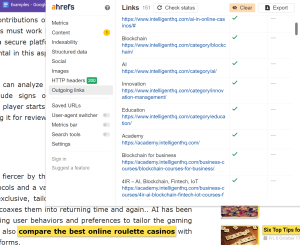
- If you needed to add an internal link from this site, you could choose a page from a different section, as there are plenty of pages not about casinos.
External links should not be to a company’s homepage and should instead be relevant and informative. Similarly, the anchor text used to add the link should be relevant to the page you are linking to. Try not to link to basic definitions and instead choose something more informative. For example, in this article, the writer originally linked to Investopedia’s definition of blockchain when there were plenty of opportunities to link to some news/stats about the crypto projects (I replaced it with a link to Binance’s page about how much Bitcoin Minetrix has raised.
We can use the main category page for some sites when every other article is a competitor’s guest post. However, this is a general sports news section so there are plenty of articles without links to other betting brands (see new internal link below).
Before: But will basketball itself prove to become even more popular, thanks to the amazing spectacle that was the World Cup earlier this year?
…
However, as to whether or not the FIBA World Cup will raise interest in basketball in the Philippines, given the extreme popularity that the sport already boasts in the country, only time will tell.
After: But will basketball itself prove to become even more popular, thanks to the amazing spectacle that was the World Cup earlier this year?
…
However, as to whether or not the FIBA World Cup will raise interest in basketball in the Philippines, given the extreme popularity that the sport already boasts in the country, only time will tell.
Guide to Natural Anchors
- Our anchor* link, of course, needs to be relevant to the article’s content and weaved-in in a natural way.
- The surrounding text and article needs to be relevant to the destination of the anchor link
- The anchor should be placed naturally and within context. DO NOT create an ad-hoc paragraph or section that is out of topic or very promotional. If creating it makes it within context and natural then we can go ahead.
- See here an example of what not to do. The article here creates a specific section which is out of context just to place the anchor
- See here examples of how to naturally add our anchor to the text.
- Please be sure that you do not repeat anchor paragraphs, or the sentence surrounding the anchor. These have to be unique for every article as they will be passed off as plagiarism.
- Our anchor link should be placed as high as possible in the article. Do not force this if it’s not natural.
- Best for the anchor to be placed within a sentence.
- If the anchor is placed as a source DO mention content from the URL. Example of anchor:
Source: https://www.business2community.com/gambling/texas-sports-betting
In the case of naked anchors*:
- We wish to have it mentioned as a SOURCE or REFERENCE in brackets or ACCORDING TO
Example:
- ¨Before you think about which NFL and NBA teams to bet on, pick a reliable and trusted betting website. California is yet to legalize sports betting. However, its current laws allow Californians to bet at offshore betting sites
- (Source: https://sportslens.com/)
- Alien Worlds, according to Safe Betting Sites data, had the highest player count among NFT games in the preceding 30 days prior to October 21, 2021 – an estimated 759,600 users.
- In cases like this where we have a generic anchor* (“list of sites“) make sure that we have a key term (“offshore casinos” in the case of this target URL) in the same sentence where our anchor is. This is important. Same goes for brand anchors. For example: if we have the anchor “BasketBallInsiders” with the target URL https://www.basketballinsiders.com/online-casinos/ ,in the sentence where our anchor is placed we need to have the term ¨online casinos¨ mentioned
- We will usually indicate this in the shared sheet
- We will usually indicate this in the shared sheet
- If an anchor is “natural”, this means that it does not have to contain words included in the URL.
For example, if the URL is https://www.techopedia.com/gambling/new-zealand/1-dollar-deposit-casinos
The anchor should not include “gambling” “new zealand” “1 dollar deposit” “casinos” or any combination of these.
In these cases words like “here” or “information” work well.
Formatting
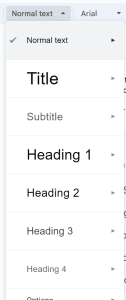
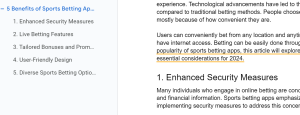
- Start with the main title in H1, then subsequent headings in H2. If needed, H3s to break down further points. You can easily do this with Google Docs:
- If there is a number in the main title, it makes sense to also list the subheadings.
Before:
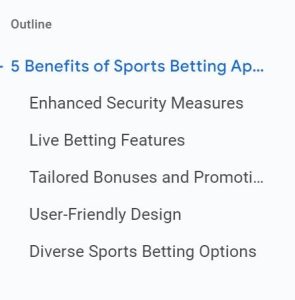
After:
- There is no need for a H2 like this when all the points belong to a list:
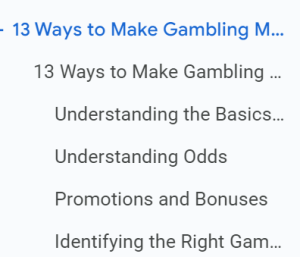
Instead, we can have H1 “13 ways to…” then each of the points as H2s.
- Stick to a consistent font, size, and spacing.
Author Mentions
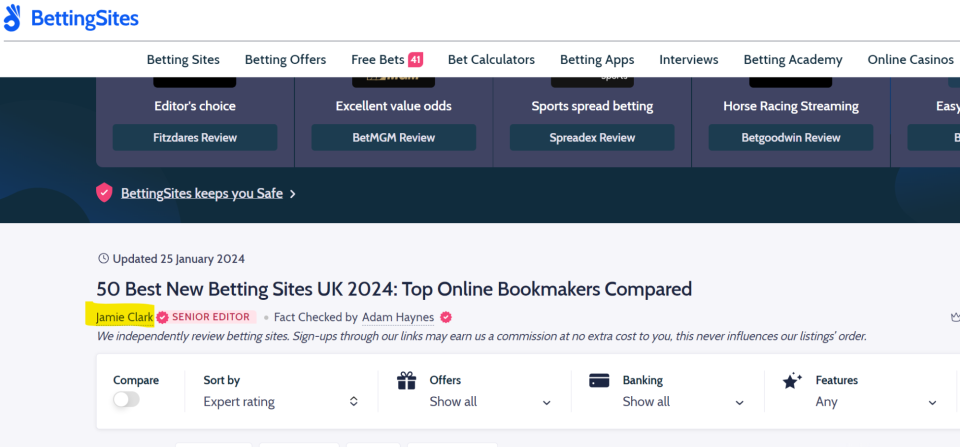
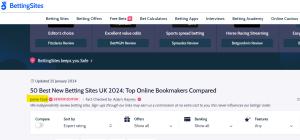
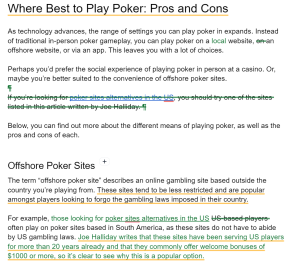
We want to build authority by mentioning the author of our target page in as many articles as possible, near the anchor. You can see their name at the top (or sometimes the bottom) of the target page (here it is Jamie Clark):
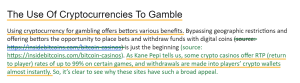
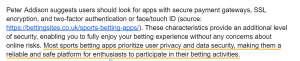
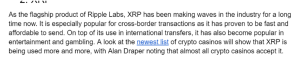
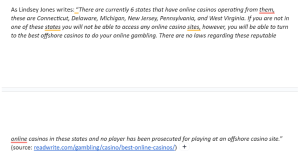
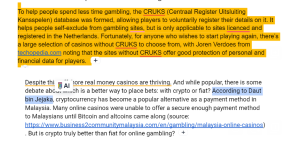
There are a few ways to do this; here are some examples showing how the text has been edited to naturally add the author’s name:

Images
- Normally, webmasters add images to the articles themselves. However, it can be easier for them to receive one/two images from us included within the text, so please add an image unless asked not to.
- Always make sure to use royalty-free images. This is very important to avoid any legal issues when it comes to copyright.
-
- Here are some links to databases of copyright-free images:
- In order to avoid any issue: please read the instructions every time you are downloading a picture – just to be aware of any changed rules regarding the copyright of the images you want to use.
Glossary
Here, you can find definitions for all the words marked with an ASTERISK (*) and others also, to help get a better understanding of the specific vocabulary tied to writing content.
Domain: The provided website on which we are publishing the article.
Target URL: The link to the client’s website which we are linking to to advertise through the article.
Anchor: The given text under which the target URL will be embedded.
Internal Link: A link to a separate article from the given domain.
External Link: Link to high authority and non-competitor websites to improve authority.
(helps to make the article not look like it’s linking out to only one site, making it look less like an advertorial).
Heading: The title of an article or subtitle to a paragraph (on the taskbar at the top left of the document, you have a drop-down button that says normal text; once clicked, you will uncover heading format options, starting from H1, H2, etc…).
Naked Anchor: client’s link text which is not a phrase, instead in the form of just the name of the company (example: Basketball Insiders) or just a normal link (example; https://www.basketballinsiders.com).
Generic Anchor; An anchor text that does not mention any name of company or topic (example: list of sites).
Processes
This is the sheet that we will use to order articles. In this sheet we will provide the following:
- GEO: What country or region the URL is from and hence the article should be focusing on (in terms of writing style – UK English versus US English – or topic, etc).
- Domain: the website in which the article will be published
- Target URL: the URL we want the article to link to.
>> THE ARTICLE SHOULD BE RELEVANT TO THIS URL AND PLACE NATURALLY WITHIN CONTEXT
- Anchor: the text that will be used to link to the target URL
- Topic ideas: we won’t always provide topic ideas. In the cases in which we don’t provide them we will expect you to do it.
You will provide:
- Topic ideas: in the cases that we haven’t included them.
- Length: according to the domain’s style (as per above guide)
- Potential title: the title the article will have
- Structure: we don’t need a thorough brief but the structure should follow the domain’s general style (as per the above guide) and the articles you provide shouldn’t all follow the same structure necessarily. The structure brief will be more for your internal use.
>> THE TOPICS AND THE TITLES ARE NOT THE SAME. Might be cases in which they are very similar but we don’t want you to use the topics as literal titles.
Deadlines:
- Topic suggestions: 1 day after we provide the domains (and only if we haven’t suggested a topic)
- Article delivery: 1 week since the topic it’s approved (if we provide the topic the week will come from that date)
- Rewrites: 2 days since notified
We will provide deadlines. PLEASE, if you can’t commit to them let us know in advance and we will adapt.
The shared sheet contains different statuses that they SHOULD BE USED according to the following instructions (so we know at every time how things are progressing):
- Topic approval: the topic you suggested is ready for us to check
- Topic approved: the topic is approved (either because we suggested it or because we are happy with the one you suggested)
- Pending: the article is being written
- Ready: the article is done for us to check
- Ready Nemanja: the article is approved by us and ready to be sent out
- Forwarded: we have sent the article out to the webmaster
- Live: the article it’s published
- For links that we buy through you please also place the live URL